You’re assigned to a new project. You review the expectations and wonder how quickly you can get up to speed.
A new supervisor arrives. You prepare to explain what you do and demonstrate that they can rely on you.
Or your responsibilities shift gradually, until you realise that your working week looks very different from the role you originally accepted.
In each situation, there are expectations to understand and relationships to build. There is also a question worth bringing into the conversation early:
What could this work help me become better able to do?
A role transition gives you a reason to discuss the shape of your work. That includes what the organisation needs, what you can contribute, and where you want to grow.
You may have limited influence over the assignment. Even so, identifying one useful change can give you something concrete to discuss.
Understand what is changing
Before proposing a development opportunity, understand the assignment.
With a new project, clarify the problem, expected outcomes, and decisions you will own. With a new supervisor, discuss priorities and working expectations, even if your job description remains the same.
Three questions can help:
- What would a good contribution from me look like over the next three months?
- Which decisions should I make independently, and when should I involve you?
- Which existing responsibilities become less important as this work begins?
That last question matters. A transition can add work without removing anything.
Notice your own reaction, too. You might feel excited about the opportunity and anxious about proving yourself. If your immediate instinct is to accept everything, pause long enough to consider what you are agreeing to.
Being clear about capacity helps you make a proposal you can sustain.
Give your long-term vision a practical shape
“Long-term vision” can sound as though you need a detailed career plan. A direction is enough to begin.
Perhaps you want to become someone who helps teams make difficult decisions. Perhaps you want deeper technical expertise, more creative ownership, or work that brings you closer to the people it serves.
Ask yourself:
What kind of contribution would I like to make more confidently a year from now?
Then look for evidence in your experience. When have you felt absorbed, useful, or proud of how you worked? Which activities would you willingly practise again, including their less enjoyable parts?
Self-determination theory identifies autonomy, competence, and relatedness as basic psychological needs. These offer useful lenses for reflection: having a sense of choice, developing capability, and feeling connected to others. They are not a formula for choosing a role, but they can help you describe what you want more clearly. Self-Determination Theory
Your answer might be:
“I want to become better at helping people with different priorities reach a workable decision.”
That gives you something to connect to the new assignment.
Find a responsibility that serves both purposes
Look for an overlap between your direction and the work that needs doing.
Researchers Amy Wrzesniewski and Jane Dutton describe job crafting through changes to tasks, workplace relationships, and how people understand their work. This provides a useful starting point for thinking about the parts of a role you might shape. Michigan Ross
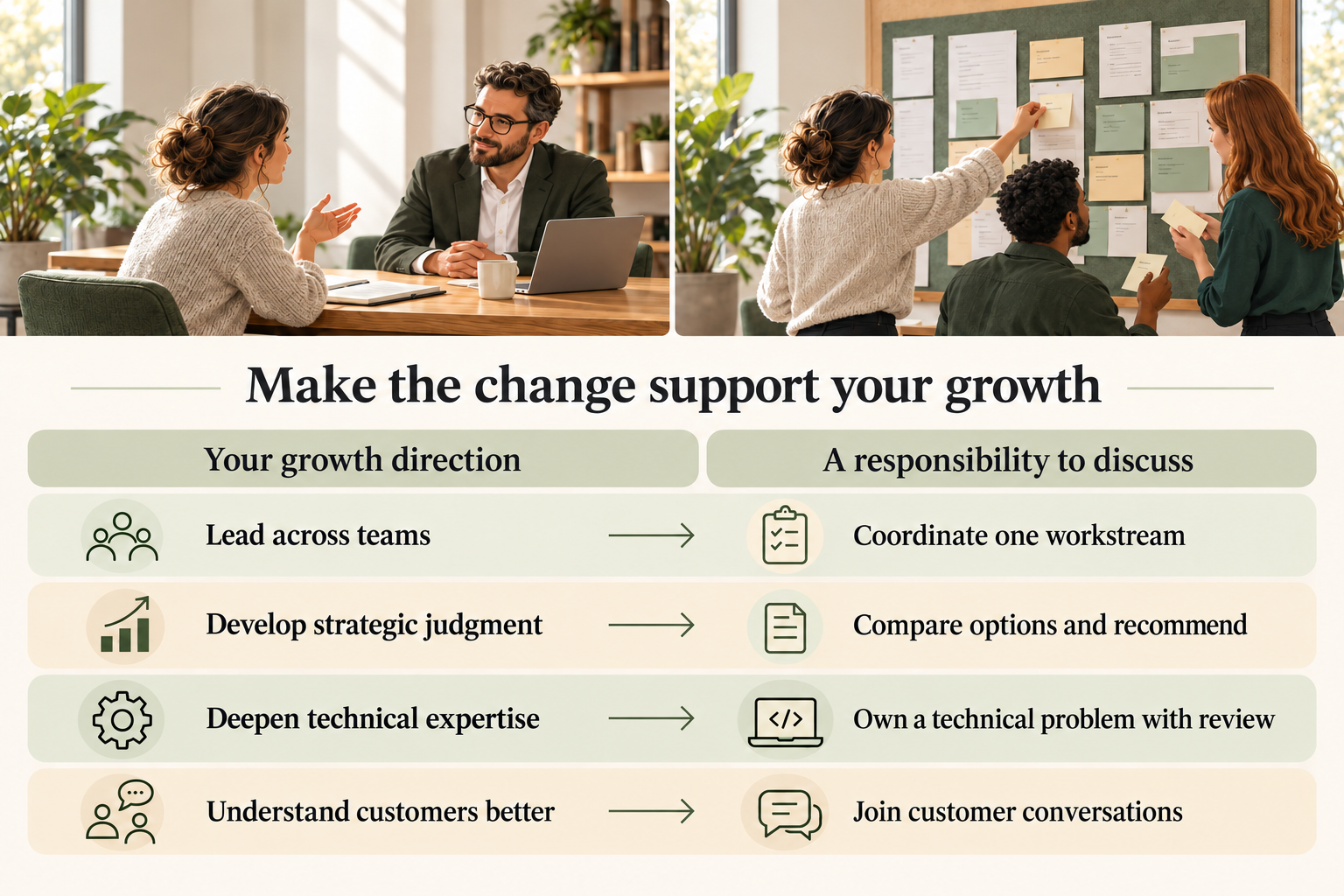
For a role transition, turn that idea into a specific proposal:
| Your growth direction | A responsibility to discuss |
|---|---|
| Lead across teams | Coordinate one workstream with clear decision boundaries |
| Develop strategic judgment | Compare options and present a recommendation |
| Deepen technical expertise | Own a bounded technical problem with expert review |
| Understand customers better | Join customer conversations and translate findings into project decisions |
Choose something that belongs in the project and gives you repeated opportunities to practise.
Imagine an analyst who wants to develop toward product management. Preparing another reporting pack may offer limited practice in understanding user needs. Owning the requirements conversation for one dashboard could provide a closer connection—if the project needs it and the relevant people agree.
The useful question is: Where will the capability actually be exercised?
Make the proposal easy to discuss
Your supervisor may be concerned about delivery, risk, workload, or your readiness. Explain how your proposal addresses those concerns.
You could say:
“This project needs someone to coordinate the handoffs between the two teams. I’d like to take responsibility for that because I want to develop my ability to lead across teams. Could we start with one workstream, agree which decisions I can make, and review the first milestone together?”
Then discuss capacity:
“To make room for this, could we reduce the weekly reporting task or move part of it elsewhere?”
Agree on the responsibility, the support available, the work that will change, and when you will review the arrangement.
An encouraging “yes” becomes more useful when both of you know what it means in practice. Send a short written recap so you can return to the same understanding later.
Make room for learning
A demanding assignment can involve learning, but difficulty alone does not tell you whether you are developing the capability you intended.
For the responsibility you agree on, identify someone who can give useful feedback. Ask about a specific action or decision:
“When I led that discussion, where did I help the group reach a decision, and where did I make it harder?”
If you have little influence over your role, make the request smaller. You might observe one planning meeting, draft a recommendation for review, or own a single handoff.
Some workplaces cannot or will not provide the opportunity you need. That limitation is information about the role. It does not mean you failed to communicate your ambition well enough.
Review the direction as well as the delivery
Choose a review point that fits the project—perhaps after the first milestone or six to eight weeks. This is a practical suggestion, rather than a research-established interval.
Discuss what you delivered, then examine what you learned:
- What did I actually get to practise?
- What feedback changed how I work?
- Do I want more of this responsibility?
- What needs to change for the next stage?
You may discover that the work fits your direction. You may also learn that an ambition feels different once you experience its daily demands. Either discovery can help you choose more deliberately.
Give your future a place in the working week
Your next role does not need to contain your entire future. It can contain one responsibility that helps you explore it.
Before your next project or supervisor conversation, complete this sentence:
“By the end of this assignment, I want to be better able to ___, and I will practise that through ___.”
If you use DeepMirror, bring that sentence into a self-check-in. Reflect on the work that gives you energy, the values you want to express, and the capability you want to develop. Use what you notice to prepare one concrete request.
Your longer-term direction becomes easier to act on when it has a place in your actual responsibilities.
Sources and further reading
- Michigan Ross. Personal Stories Illuminate Three Main Types of Job Crafting.
- Self-Determination Theory. The Theory.
The workplace scenarios and suggested wording are illustrative examples. The hero image is AI-generated.