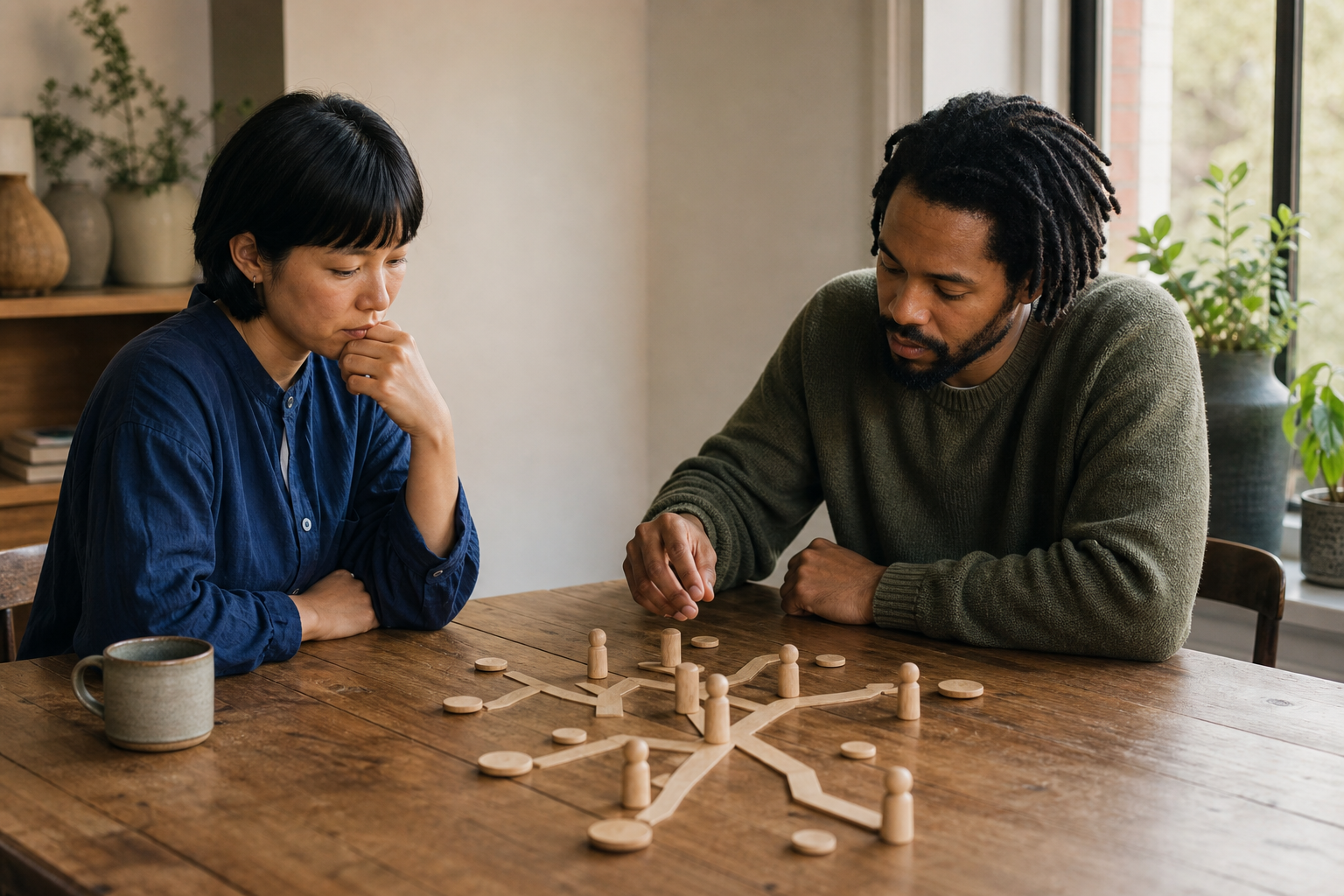
A colleague asks you to support a risky proposal. Do you cooperate, protect yourself, or wait to see what everyone else does?
A group project is consuming more time than it is worth. Do you stop—or continue because you have already invested too much to walk away?
Someone rejects an offer you considered reasonable. Do you conclude that they are irrational, or ask what fairness looks like from their side?
These questions sound different when we discuss them calmly. Inside the moment, uncertainty, pride, fear, habit, and social pressure begin competing for control.
Advice can tell us to communicate clearly, protect our boundaries, cooperate wisely, or let go of sunk costs. The difficulty is recognizing when those ideas apply—and acting on them before an automatic response takes over.
Games can help because they turn an abstract principle into a choice.
A game makes the invisible structure visible
Human interactions contain more variables than we can consciously track. We are considering what we want, what another person might do, what they think we might do, what feels fair, what could be lost, and whether today's choice will affect tomorrow's relationship.
A well-designed behavioral game temporarily simplifies that complexity. It might isolate cooperation versus self-protection, fairness versus leverage, immediate reward versus long-term sustainability, escalation versus restraint, or words versus credible action.
This simplification gives the pattern a shape. We can observe the choice, the assumption behind it, and the consequence that follows.
Researchers have long used strategic games to study social decisions involving cooperation, reciprocity, fairness, trust, and adaptation. These games do not reproduce the whole of human life, but they can reveal how decisions change in response to incentives, other people, and previous outcomes. A review in Nature Neuroscience describes how game-theoretic tasks have been used to investigate these features of social decision-making.
Knowing the principle is not the same as recognizing the moment
Consider the advice, "Do not continue investing merely because you have already invested heavily." The principle is straightforward. Yet sunk costs become harder to recognize when the investment is your own: six months of effort, a public promise, an expensive purchase, or a goal tied to your identity.
A game can recreate the structure without reproducing the full real-world cost. You make another investment. The situation deteriorates. You feel the pull to justify what has already been spent.
"I am not continuing because the next step is valuable. I am continuing because stopping would force me to reconsider the steps behind me."
Now the concept is no longer just a definition. It has become a recognizable experience. That recognition is the bridge between knowledge and behavior.
The learning happens after the choice
Playing alone is not enough. A person can repeat the same strategy, receive a score, and leave without understanding what happened.
Research on game-based learning supports this distinction. A meta-analysis by Pieter Wouters and Herre van Oostendorp found that instructional support—such as feedback, guidance, and help identifying relevant information—improved learning within game-based environments, particularly for skills. The authors also found evidence of publication bias, so the result should not be treated as a universal guarantee.
Evidence across serious games remains mixed. A review of randomized trials in health-professions education found little advantage over other educational approaches on several outcomes, apart from a small effect on confidence. A game's existence alone does not make it effective.
Structured reflection appears to be important in experiential learning more broadly. A meta-analysis of individual and team debriefs found meaningful performance improvements when people systematically examined what happened and what to change.
The score is not the insight. The insight begins when we ask why we made the choice.
Two ways to practice: build range or rehearse your reality
You do not need an existing DeepMirror history to begin.
Practice across work, friendships, family, study, shared projects, personal goals, and everyday decisions.
Use relevant themes from your check-ins to bring the same behavioral principles closer to situations in your life.
Generic mode helps you encounter the same behavioral principle in different settings. That builds range: the ability to recognize cooperation, escalation, reciprocity, or a sunk-cost pattern even when it appears in an unfamiliar form.
As you complete check-ins, you can choose Personalized mode. DeepMirror can then use relevant context from those reflections to shape the setting, conflict, or role in a game. A lesson about trust might appear in a situation resembling a current collaboration. A sunk-cost exercise might reflect the kind of commitment you have been questioning.
The game does not decide what you should do. Personalization changes the practice context, not the underlying principle, and you can switch between the two modes.
What DeepMirror's games let you practice
DeepMirror's Game Lab uses short scenarios, choices, consequences, explanatory feedback, and progressively more difficult levels to explore recurring patterns in human interaction.
Notice when past investment—rather than future value—is keeping you committed.
Explore when cooperation is rational and when self-protection creates a worse shared result.
See how fairness, leverage, and rejection thresholds shape what another person can accept.
Practice recognizing authority, defensiveness, curiosity, and adult-to-adult collaboration.
Experience how shared resources grow or collapse through contribution, free-riding, and group norms.
Distinguish a firm boundary from pressure that makes future cooperation less likely.
Other games address coordination, reciprocity, sacrifice, conflict posture, undercutting, shared resources, long-term trust, and credibility signals. None can tell you who you are. Their value is in giving you a pattern to notice, a decision to examine, and another strategy to try.
Practice creates a pause before the real moment
The most useful outcome of a behavioral game may not appear while you are playing. It may appear two days later, when you recognize the structure:
- "We are all waiting for someone else to take responsibility."
- "I am escalating because I want certainty, not because more pressure will help."
- "I am treating their caution as betrayal."
- "We are competing downward because neither of us expects the other person to hold the line."
- "I want to recover what I spent, but that cost is already gone."
The real transfer is not memorizing the name of a theory. It is gaining enough familiarity with a pattern to notice it while choices are still available.
Turn one game into a real-life experiment
After playing, pause before starting the next level. Ask:
- What was the observable situation? Leave out motives and interpretations.
- What did I want to protect or achieve?
- What did I assume the other person would do?
- Which emotion or impulse influenced my choice?
- What consequence did my strategy create for me, the other person, and the wider system?
- What alternative strategy became visible after receiving feedback?
- Where does this pattern appear in my life, and what small response could I test next time?
Play to understand, not merely to win
Human behavior is difficult to learn from definitions because behavior unfolds between people, under uncertainty, with something at stake.
Games give those forces a smaller stage. They let us examine cooperation without demanding blind trust, fairness without pretending everyone agrees, and conflict without reducing every interaction to winning or losing.
The purpose is not to discover the perfect move. It is to become more curious about the move you make automatically—and more capable of choosing another one when real life presents the same pattern in a less obvious form.